How does a project of this nature progress when there are 2 type A personalities trying to agree on the location and design of the shop/garden shed? Slowly!
With almost 2 acres of property, one would not think it would be a big deal to agree upon the location. However, we have had some obstacles to overcome. First, and foremost, is to make sure we don't create more of a water run off issue for our neighbors during the rains and monsoon season. Second, there is the water main to the house that we can't build over and happens to be located in a prime building spot. Third, the electricity drop that comes from the pole to the house and is in the way of the same very suitable location. Fourth, size and orientation of the shop itself. Fifth, easy access from the street and the house. Sixth, we want it to blend in with the house structure. Wow, no wonder it has taken so long for us to agree!
After much back and forth, we have come to an agreement! Amazing, when one considers that we had only been at it for four weeks as of mid-February.The learning curve was just beginning!
Preliminary discussion with the zoning folks revealed a couple of items.
1. If the shop is detached, it can only be 1/2 the size of the house and only 10' tall. So much for a 32'X45' shop with an RV bay.
2. If the breeze way is attached between the shop and the house, there is no limitation. The 32'X45' shop with an RV bay is back on the drawing board!
3. There is a 20' set back from the property line AND we cannot build over the water line (which we knew). The shop size must be reduced to 30'X40', and the RV bay can stay.
The ironic part is that we originally discussed the size of the shop as 30'X40'. However, as Dave kept planning, the size kept growing. It is funny how plans come full circle!
In order to get the darn building permit, we had to hire an architect to design the shop (to show the structural components such as cement pad and footers, electrical, roof trusses, and etc). That has taken another four weeks. Here is the rendering of the front and west side.
With the drawings in hand, Dave and the architect set out to walk the submission through the approval process last Monday (March 15). They got 90% approval.
There appears to be a new building code that the architect didn't know about. Because of the ceiling height on one side of the shop, which is for an RV bay, and because of the high winds that occur in Tucson on a regular basis, the four corners must be reinforced for wind shear. Who would have thunk! So now we wait for the structural engineer to add the appropriate information and take one more run at the approval process. Hmmm, another 10 day delay.
I was really hoping that construction would be well under way by now. Lesson in patience. "Patience" seems to be the mantra with all of our projects at the moment.
Saturday, March 21, 2015
Friday, March 20, 2015
Earning their keep....
Where would we be without Alice and Tiny; especially Alice!
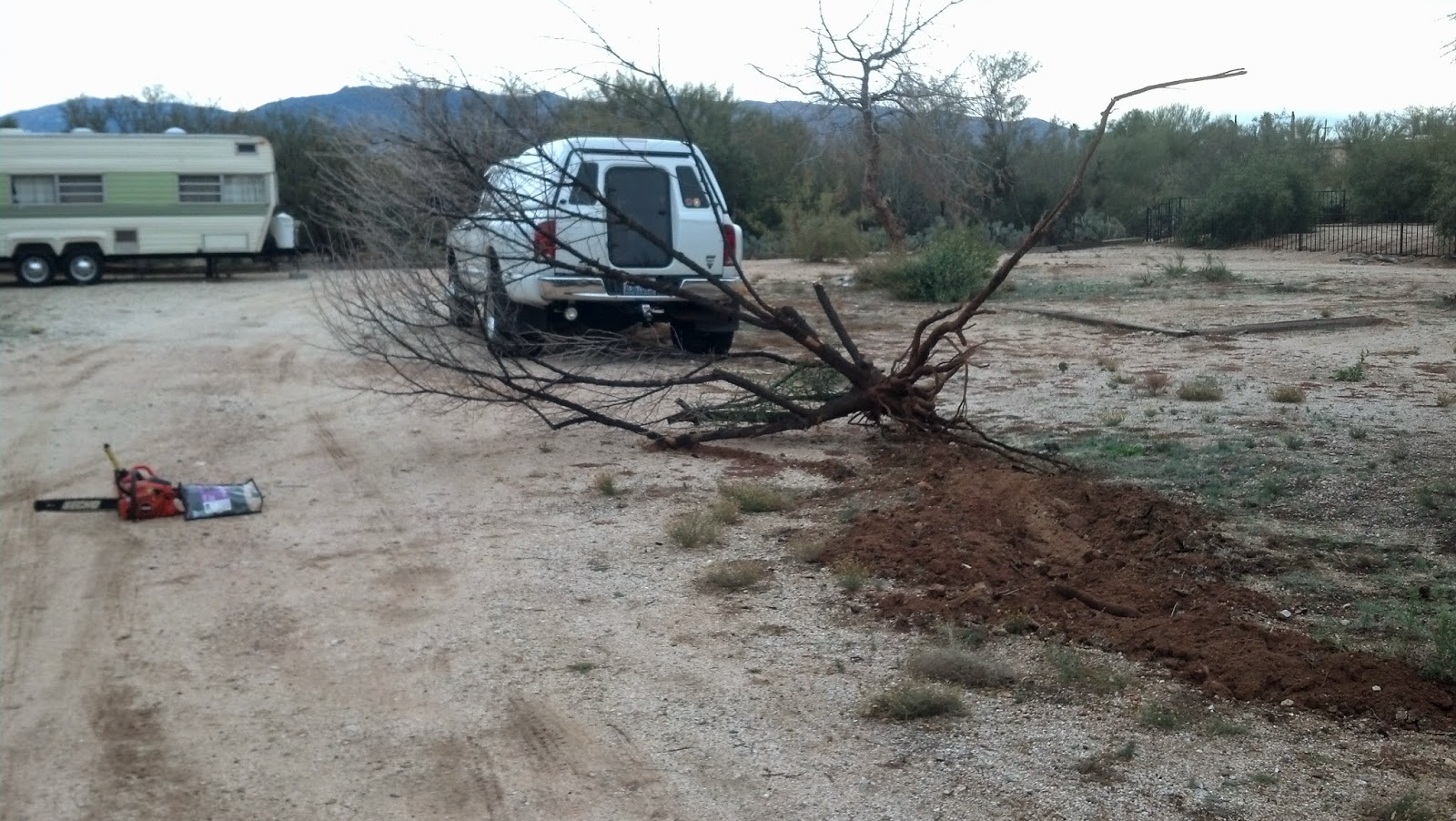
Tiny is a workhorse. Thank goodness for its pulling power as we have had to pull up trees and stumps. Sometimes you just need brute force to get the job done.
However, Alice has been no slouch! She has been very instrumental in getting the property cleared of the overgrowth and railroad ties.
What have we been clearing? First and foremost, the spot for the shop. Railroad ties, clothes line, rocks, cactus all had to be removed. And as best as Alice could, the ground leveled.

Second, comes the cleansing of the Prickly Pear overgrowth. We certainly won't clear the property of all Prickly Pear, but it must be beat back to a manageable parameter....away from the house and cars. Prickly Pear cactus becomes home to the pack rat. The pack rat is a cute but destructive little rodent, gnawing on anything, including vehicle wiring harnesses! The Prickly Pear also has nasty spines. It's not the long ones that hurt. There are small, almost invisible clusters that work their way through clothes and gloves to your skin to your skin.
Friday, January 2, 2015
One Thing Leads to Another...
...or how we take one step forward in order to take two steps back!
The house is not on the city sewer system which means we have a septic tank. Having had the "pleasure," in my past life of digging up the septic tank at the most inopportune times to be pumped, I suggested that we have a pipe installed to make it easier to pump, since we had to locate the tank opening anyway. Mind you, this started as part of a project to locate the septic tank/leach field which is part of the landscape planning project for the area between the house and the street; specifically planning the water diversion area for managing the monsoon waters that flow through the front area. (It is all so interconnected. Hopefully I didn't lose you on this one.
Dave got out the diagram from the house inspection and proceeded to dig. Once he located the tiny little take out hole on one end of the tank, he continued to dig for the second take out hole. Excavating a 4' X 8' hole didn't expose the blasted 2nd take out hole, but it did provide plenty of room to install a riser over the one hole so that we don't have to dig so much again. Or in Dave's words, he just dug his own grave. Take your pick.
Let me explain. A riser is a 24" heavy duty tube that fits over the take out hole and fitted with a secure cover. It allows access to the septic tank for general maintenance without digging to China each time. Should be simple enough, right? This is where it became fun.
Take a step back. During the house inspection, the septic tank had to be certified as recently pumped and fully functional. According to the inspection report (March 2013), the tank had been pumped September 2012. That means it had been fully cleaned out of everything within the tank. (Keep that in mind.)
Fast forward to installing the riser.
1. The take out hole was only 8" in diameter. Probably code in 1976, but not so much now.
2. The riser tube is 24" in diameter. It needs to fit tightly into the hole. The hole needed to be made bigger.
3. Some idiot allowed trees to grow over the tank. Big no-no due to roots going for the water. We had already removed one tree that was right at the end of the big dig.
4. Upon inspection, two things were evident. First, the Oleander right in front of the house (in background in picture above) had grown roots into the tank right at the point of the take out hole. There was no way that a hose could be inserted into the tank for proper service. Second, the tank had not been properly pumped in forever, despite the "certified" report to the contrary.
5. Upon rereading the home inspection report, the shower drains were slow and had to be snaked. It appeared to the pipe to the tank had roots recently removed. Makes sense when taking into account #4 above.
So what started as a project to make our lives easier in the future ended up being a bit of a set back. In the end, it turned out to be a good thing. The Oleander has been removed. We now have a properly cleaned tank and a riser that will make the job easier for the next service call, in about 5 years. We still don't know the location of the leach field, but we do know it was recently replaced. We will just need to tread lightly when shaping the front area for water abatement.
At least now we can move forward.
The house is not on the city sewer system which means we have a septic tank. Having had the "pleasure," in my past life of digging up the septic tank at the most inopportune times to be pumped, I suggested that we have a pipe installed to make it easier to pump, since we had to locate the tank opening anyway. Mind you, this started as part of a project to locate the septic tank/leach field which is part of the landscape planning project for the area between the house and the street; specifically planning the water diversion area for managing the monsoon waters that flow through the front area. (It is all so interconnected. Hopefully I didn't lose you on this one.
Dave got out the diagram from the house inspection and proceeded to dig. Once he located the tiny little take out hole on one end of the tank, he continued to dig for the second take out hole. Excavating a 4' X 8' hole didn't expose the blasted 2nd take out hole, but it did provide plenty of room to install a riser over the one hole so that we don't have to dig so much again. Or in Dave's words, he just dug his own grave. Take your pick. Let me explain. A riser is a 24" heavy duty tube that fits over the take out hole and fitted with a secure cover. It allows access to the septic tank for general maintenance without digging to China each time. Should be simple enough, right? This is where it became fun.
Take a step back. During the house inspection, the septic tank had to be certified as recently pumped and fully functional. According to the inspection report (March 2013), the tank had been pumped September 2012. That means it had been fully cleaned out of everything within the tank. (Keep that in mind.)
Fast forward to installing the riser.
1. The take out hole was only 8" in diameter. Probably code in 1976, but not so much now.
2. The riser tube is 24" in diameter. It needs to fit tightly into the hole. The hole needed to be made bigger.
3. Some idiot allowed trees to grow over the tank. Big no-no due to roots going for the water. We had already removed one tree that was right at the end of the big dig.
4. Upon inspection, two things were evident. First, the Oleander right in front of the house (in background in picture above) had grown roots into the tank right at the point of the take out hole. There was no way that a hose could be inserted into the tank for proper service. Second, the tank had not been properly pumped in forever, despite the "certified" report to the contrary.
5. Upon rereading the home inspection report, the shower drains were slow and had to be snaked. It appeared to the pipe to the tank had roots recently removed. Makes sense when taking into account #4 above.
So what started as a project to make our lives easier in the future ended up being a bit of a set back. In the end, it turned out to be a good thing. The Oleander has been removed. We now have a properly cleaned tank and a riser that will make the job easier for the next service call, in about 5 years. We still don't know the location of the leach field, but we do know it was recently replaced. We will just need to tread lightly when shaping the front area for water abatement.
At least now we can move forward.
Sunday, December 28, 2014
Meet Alice
Getting older hopefully means that you get smarter. We immensely enjoy the "do-it-yourself" approach and also know that the right equipment makes the job oh so much easier. When it comes to the property, Dave decided that the one piece of equipment that would make our projects easier is a tractor with attachments. It will also save our backs when it comes time to dig out and shape the water channels.
At first, he was looking at larger John Deere type tractors. I wasn't sure about it as they were big and would require the purchase of the attachments. Then he found Alice on Craig's List. It was a go!
Meet Alice. Alice is a 1968 B-110 Allis-Chalmers garden tractor. It is perfect! It comes with several attachments including a front plow, grader, disc, little wagon, and lawn mower deck (which we don't need, but came as part of the package).
Alice has already proven her worth with small stump pulling. Dave can then grade over the gaping holes so that cars and small children don't fall in!
You will see more of Alice as the renovations progress.
Saturday, December 27, 2014
Before and Current

We bought our house in April 2013. At that time, the grounds were not over grown. My oh my, what a difference 18 months makes! Here are a few shots of the grounds at that time of purchase or shortly thereafter. The appeal to the property, aside from a single level home, was the possibility of a clean slate.
Front view of the NE (left) and NW (above) view of house and front drive Notice how "clean" it looks and how small those cute little bushes are. Aside from the apparent stumps, doesn't look like much needs to be up cleared out. We can just start the landscaping. Keep reading and hold on to your hat!
Back view from the NE (left) and NW (below with nephew Michael). A few small "trees" and shrubs along with the palm trees (Dave's favorite tree, by the way). 
Also notice the railroad ties. There are hundreds of them! We learned the history of the ties from our neighbor David. The former owner and neighbor David worked for a railroad. They liberally helped themselves to the ties. The landscaping was born! The ties go!
We did not ask our tenant to take care of the "yard" so literally nothing was done from the time he moved in until we moved in. When we drove up in September to park Lucille, the property looked like it had gone back to the wild. I wanted to cry. The "clean slate" had gone wild! So before we can even begin the landscaping, we are digging and pulling the over growth.
To the right is a picture from the street of the NW corner of the front of the property. In the forefront is just a glimpse of how the drive way has washed out.
The NW back corner with a ton of over growth. This is how fast the African Sumac grows and spreads! In the very front of this picture is a small Desert Broom plant. Some of them had gotten over 3' high in the front of the property.
To be sure, we are not trying to clear the entire 2 acres. But we do want to clean out a nice little living space that invites birds and wonderful outdoor living.
To add to the fun, the monsoon season, which was heavier than usual for this year, managed to turn the front area into a river bed. From the positive perspective, I would rather know now that we have to fix the drainage rather than have the newly installed landscaping wash away. It gave us a different perspective on what needs to be done in the front. The challenge is to channel the water without flooding out our neighbors that are on the downside of our little estate. We will certainly learn about culverts and water diversion! And in the meantime be able to channel water to feed the trees and other plants.
Long story short, in a really backhanded way, the neglect of the property is a blessing in disguise. As we are cleaning the slate, we are learning the property. It will certainly help us better design the water diversion landscaping.
More to come!
Friday, December 26, 2014
A Different Sort of Adventure
I'm taking a few liberties to write about our adventures at "home." Justification - Tiny and Lucille both live on the property and Tiny has been very instrumental thus far in clearing out the property of dead trees and stumps. So the adventures continue, just in a little different direction. We were thrilled to take possession of our home on December 1, 2014. However, the trailer with the furniture was still at the terminal and would not be delivered for another few days. Thank goodness Lucille was on the property! We borrowed her bed mattress, kitchen goods, towels and other living essentials and proceeded to camp in our house. It worked. We are no longer in a hotel!
The trailer arrived on December 3. Good grief do we have a lot of stuff to unpack! Even after selling most of our furniture and culling our clothes, we still took up 20' of the 28' trailer (9' tall, 8' wide). I felt a little better after talking with the delivery guy from Old Dominion. He has delivered as many as 2 of these trailers to a home. So in retrospect, maybe we did good almost filling just one. (If you are moving a long distance, I highly suggest checking out Old Dominion Freight Lines. You pack, they pick it up and deliver it. It beats driving a UHaul.)
The new washer/dryer and fridge arrived December 3. The bedroom set arrived a week or so later. It was so nice to get off the floor! These should be our last large furniture and appliance purchases unless the workmanship has built in obsolescence. Well, I take that back. We still need a couch or something for our family area. While we do have interim chairs (Dave's marshmallow couch and a vintage easy chair) to sit on, it provides limited seating when company comes over.
It has been a whirlwind since we moved in. Unpacking the moving trailer, unpacking boxes (more to unpack), starting the yard demolition, meeting neighbors, out of town company (already!), finding a hair stylist, learning how to use the garden tractor, yard demolition, finding the dump that takes clean green, more yard demolition.......
Saturday, November 22, 2014
Dave Does Zion....
To me, Zion is the reverse of the Grand Canyon. Instead of looking down from the ridge, one looks up and out from the valley floor. Your neck just swivels from bottom to top and side to side. It is beautiful; especially in the fall light.
Zion is Utah's oldest national park. It began as a national monument with a much smaller footprint. It was designated as the Mukuntuweap National Monument in 1909 by William Hartley Taft. The area of protection was expanded in 1918 and renamed Zion National Monument. A year later it was designated a national park by the Woodrow Wilson administration.
The last time I had been to Zion was about 18 years ago. Dave has never been to the park. The drive to the SW entry of the park was enough to whet Dave's appetite for calling it a day and getting a room for the night...or two. Springdale, UT is our home for the the next two days! The park is just a mile down the road, making an awesome backdrop for our stay.
The most popular part of the park is fairly compact. Once in the park, you take a left and drive up the canyon. The road ends in 6 miles at Temple of Sinawava. From there is a short paved walk into the canyon along the Virgin River. Beyond that, if prepared, you can walk the Narrows for quite a ways (16 miles one way). Prepared means rubber hiking boots, waders as the "trail" is all water and the water is cold, and other appropriate gear. We were not, so we did not wander this part of the park.
You can also drive through the south end of the park via a 1.1 mile tunnel and out the east side (Zion-Mt. Carmel tunnel rout). For oversized vehicles like Tiny, it requires an escort through the tunnel and an oversize vehicle fee. We'll save that drive for another visit.
Zion is Utah's oldest national park. It began as a national monument with a much smaller footprint. It was designated as the Mukuntuweap National Monument in 1909 by William Hartley Taft. The area of protection was expanded in 1918 and renamed Zion National Monument. A year later it was designated a national park by the Woodrow Wilson administration.
![]() |
| Center of Springdale, UT |
The last time I had been to Zion was about 18 years ago. Dave has never been to the park. The drive to the SW entry of the park was enough to whet Dave's appetite for calling it a day and getting a room for the night...or two. Springdale, UT is our home for the the next two days! The park is just a mile down the road, making an awesome backdrop for our stay.
![]() |
| Giant of the Patriarchs |
The most popular part of the park is fairly compact. Once in the park, you take a left and drive up the canyon. The road ends in 6 miles at Temple of Sinawava. From there is a short paved walk into the canyon along the Virgin River. Beyond that, if prepared, you can walk the Narrows for quite a ways (16 miles one way). Prepared means rubber hiking boots, waders as the "trail" is all water and the water is cold, and other appropriate gear. We were not, so we did not wander this part of the park.
| The Organ (foreground), White Throne (left background) |
Normally you must take a shuttle up the canyon as cars are not allowed during the busy season. However, the weekday shuttle stops running at the end of October (runs on the weekends through November). We lucked out and had the freedom to roam the park at will as a result.
| Canyon reflection in Middle Emerald Pool |
As with many parks that we visited this year, the best way to see many of the park features is to hike. There are many hiking trails in Zion that take you into various canyons that are not visible from the road. We wandered up to the Emerald Pools (lower, middle, and upper) to quite a spectacular view both into the canyon that held the pools and outwards toward the main canyon.
| Virgin River from the Emerald Pools trail |
You can also drive through the south end of the park via a 1.1 mile tunnel and out the east side (Zion-Mt. Carmel tunnel rout). For oversized vehicles like Tiny, it requires an escort through the tunnel and an oversize vehicle fee. We'll save that drive for another visit.
| View South from Temple of Sinawava |
There is another part of the park to the North that requires travel via freeway. The Kolb Canyon visitors center is off Hwy 15. A scenic road that will take you through the area and/or you can hike back into the arch area. The next visit!
We have run into many visitors from other countries that are in awe of our national park system. They are very thankful that our nation had the forethought to set aside so much land that cannot be developed but must remain as it is. I must agree. We have certainly enjoyed visiting many of those sites this year and hope to visit many more during our lifetime.
Subscribe to:
Posts (Atom)